It's Tuesday afternoon, and Jen, an office manager at a busy family practice, finally has ten quiet minutes. She opens the practice's Google profile and scrolls. A five-star review praises the hygienist. A three-star review mentions a confusing bill. Another five-star review says the office was great "once I finally got an appointment."
Jen smiles at the good ones, sighs at the three-star, and closes the tab. Sound familiar?
Here's the thing. Each review on its own feels like a one-off comment. Put 200 of them side by side, though, and they start telling a story. Most practices put a lot of energy into collecting reviews, and that matters. There's a whole strategy behind steady review growth that helps your practice stand out. But once those reviews come in, very few practices stop to ask what patients are actually saying.
That's where learning from Google reviews for dentists becomes your secret advantage.
For this job, think of AI as a very fast, very patient assistant who can read hundreds of reviews in a few seconds and sort them into piles.
Instead of reading reviews one by one, you ask the AI a simple question, like "What are patients complaining about most?" It reads everything and hands back a short summary. For example:
That's it. AI patient feedback analysis is really just organized reading. This is where AI genuinely helps a dental team, saving hours without replacing your judgment.
Back to Jen. One comment about billing? Easy to brush off. Maybe that patient had a bad day.
But when the AI shows her that nine different patients mentioned billing confusion over six months, it's no longer a bad day. It's a system problem.
This is the heart of the idea. A single review is an opinion. A pattern is information. Patterns help you spot small problems before they turn into the harder side of dental reviews, like a wave of angry one-star ratings. They also show you what patients love, so you can protect it, and they let you make decisions based on real feedback instead of guesses.
You don't need a big budget or a tech expert. Here's a simple way to begin.
One friendly reminder: AI is great at sorting, but it can occasionally miscount or misread tone. Treat its summary as a helpful first draft, and skim the original reviews to confirm what it found.
Certain themes pop up again and again. Here's what they look like and how to respond.
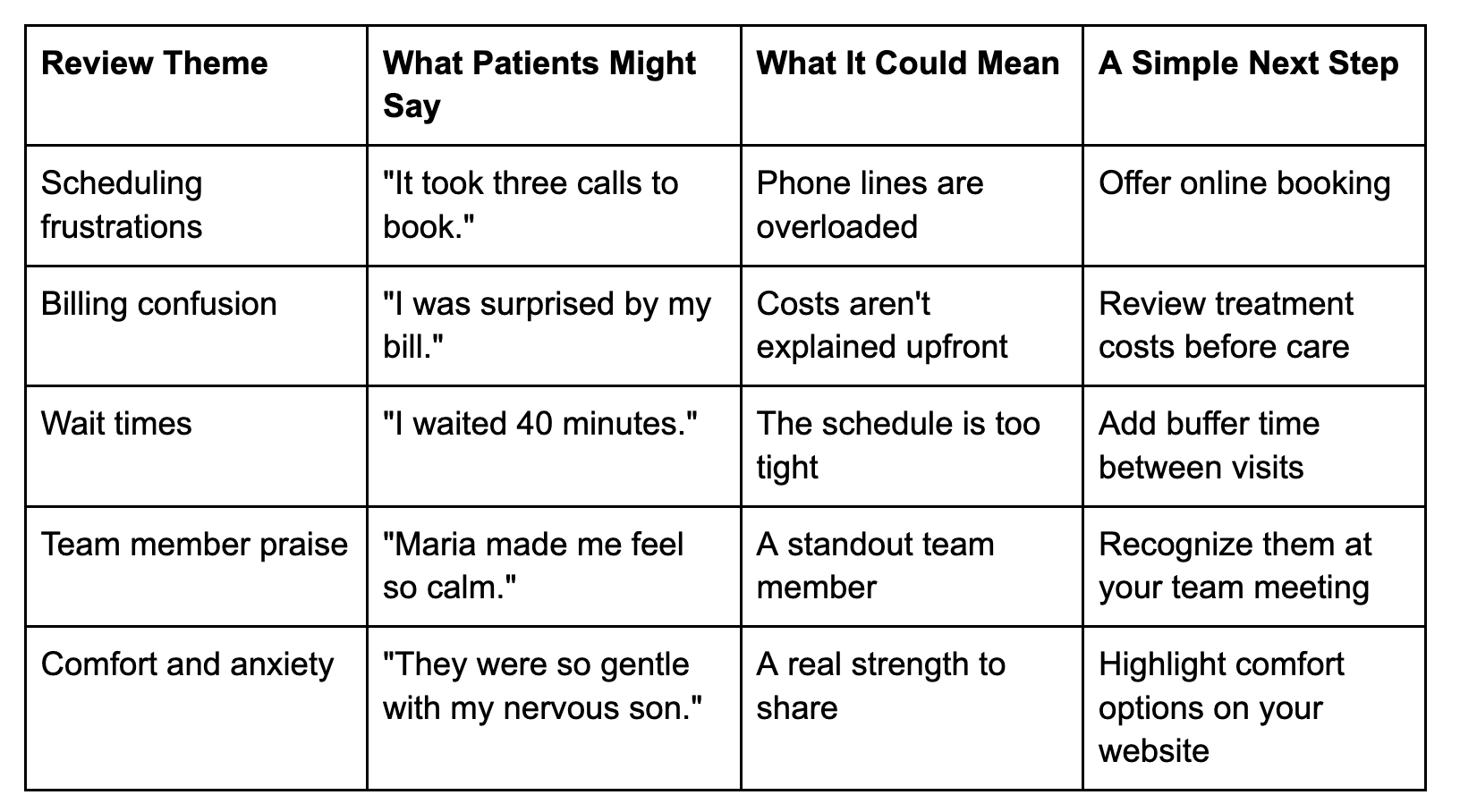
Let's walk through how Jen used her results. Scheduling came up the most, so the practice added an online scheduler that lets patients book instantly. For billing, the front desk started walking every patient through their estimate before treatment. Just two focused changes based on what patients had already told them.
Positive patterns are just as valuable as complaints.
When 22 reviews mention Maria by name, that's something to celebrate. Share those reviews at your morning huddle. Let Maria know her kindness is making a measurable difference.
Praise themes also tell you what to talk about in your marketing. If patients keep saying your team is gentle with anxious kids, that's your message. It's real, and it's in patients' own words.
Yes, and here's why. AI search tools like Google's Gemini and ChatGPT increasingly read your reviews to decide what your practice is known for. In fact, Google now uses your Business Profile and reviews in AI answers that patients see before they ever click a website. We've explored how AI search is changing patient discovery, and reviews play a big role.
So when you fix a recurring complaint, fewer future reviews mention it. Over time, the story AI tells about your practice gets better. And because fresh, recent reviews carry extra weight, those improvements show up faster than you might expect.
Once you know your themes, replying to reviews gets easier too. You'll recognize common complaints and can reply with confidence. Just keep replies general and never confirm someone is a patient or share treatment details. This guide on how to respond to Google reviews as a dentist walks through the basics.
And yes, keep collecting reviews. More reviews mean more data for your AI to learn from. If you want a head start, these ideas on how to get more Google reviews and this system for accelerating patient reviews are good places to start. The difference now is that every new review becomes a lesson, not just a number.
Your Google reviews are more than a star rating. They're a free, ongoing survey from the people who know your practice best. With a little help from AI, you can turn scattered comments into clear themes, fix what's frustrating patients, and celebrate what's working.
So what's the next step for your practice? Pull your last six months of reviews this week and ask AI one simple question. You might be surprised by what your patients have been trying to tell you.
A: AI can read hundreds of reviews in seconds and group them into recurring themes, like scheduling, billing, or team praise. It saves you from reading every review one by one and makes patterns easy to spot.
A: No. Free or low-cost tools like ChatGPT, Claude, or Gemini work well. You simply copy your reviews into the tool and ask it to find the most common themes.
A: Scheduling frustrations, billing confusion, and long wait times come up often. Every practice is different, which is why looking at your own review patterns matters.
A: Every 90 days is a good rhythm. It gives your fixes time to work and lets you track whether a theme is shrinking or growing.
A: Yes. AI search tools read your reviews to understand what your practice is known for. When fewer reviews mention complaints and more mention strengths, the picture AI shares with patients improves.