
Have you ever walked into a place where you immediately felt your shoulders drop and your breathing slow down? Perhaps a bookstore with warm lighting, a relative's home with inviting decor, or a wellness center designed for relaxation. Something about those spaces communicated safety without anyone saying a word.
Your dental practice can create that same experience. While your clinical expertise forms the bedrock of quality care, the environment you cultivate often determines whether anxious patients keep their appointments or continue finding excuses to cancel.
Dental-related fear is not a minor issue to brush aside. It creates real obstacles that affect your appointment book, your revenue streams, and your capacity to deliver complete treatment plans. Research data reveals that approximately one-third of Americans feel anxiety about dental appointments, with a meaningful subset avoiding dental care entirely due to these fears.
How does this manifest in your daily operations? Anxious patients frequently cancel with minimal notice, turn down treatment plans, need extended appointment times due to nervousness, and seldom bring new patients through referrals. In contrast, practices that emphasize comfort typically experience better retention numbers, higher treatment acceptance, and robust referral networks.
The positive reality is that reducing patient anxiety does not mean expensive remodeling projects or complete office transformations. Intentional, focused modifications can create substantial changes in how patients view and respond to your practice.
Patients begin forming opinions about your practice within moments of entering your space. Your physical environment communicates volumes before any staff member speaks. The encouraging part is that you control the elements that shape these critical first moments.
Adding plants and nature-inspired features to your reception space ranks among the most effective stress-reduction techniques available. Scientific studies from major universities confirm that exposure to greenery and natural design components helps decrease cortisol production, the body's primary stress hormone. For dental practices, this means patients arrive in a calmer state and cooperate more readily during treatment.
Try placing easy-care plants such as snake plants, pothos varieties, or peace lilies throughout your space. A compact desktop fountain can provide gentle background sound. Photography or paintings showing forests, bodies of water, or expansive natural scenes strengthens the calming atmosphere without significant expense.
Bright, cool-spectrum fluorescent lights are synonymous with medical facilities, and this association can elevate anxiety before patients reach the treatment chair. That stark, institutional brightness connects people to hospitals and urgent care centers, creating exactly the wrong mental association.
Replace fluorescent fixtures with warm-spectrum LED options that generate a gentler, more home-like atmosphere. Add table or floor lamps to your reception area to supplement ceiling lights. In operatories, dimmable lighting options allow patients to feel less exposed and more in control. Developing a welcoming practice environment begins with understanding how something as fundamental as light color temperature influences patient psychology.
Acoustic elements travel freely through dental offices. Equipment noise, suction systems, and conversations from operatories easily reach reception areas. For already-nervous patients, these sounds increase anxiety before their appointment begins.
Adding decorative acoustic panels helps absorb sound while enhancing aesthetics. Placing rugs on hard flooring reduces echo effects. White noise generators or thoughtfully selected background playlists can cover equipment sounds without creating distraction.
When your waiting room offers direct views into operatories where procedures occur, patients essentially preview their upcoming treatment. This visual exposure frequently triggers immediate stress reactions.
Simple adjustments can resolve this issue. Reorient seating arrangements so chairs face away from clinical areas. Add frosted glass dividers or attractive screens to create separation while preserving openness. The objective is providing patients mental distance from clinical imagery until they are prepared for their appointment.
Standard tall reception counters establish both physical and psychological distance between your staff and patients. When patients must look upward at team members, it reinforces an institutional power dynamic rather than a welcoming partnership.
If renovating is not feasible currently, add a lower counter section where patients can comfortably handle paperwork and engage in eye-level conversations. Even minor adjustments that bring staff to patient eye level meaningfully influence how welcomed people feel.
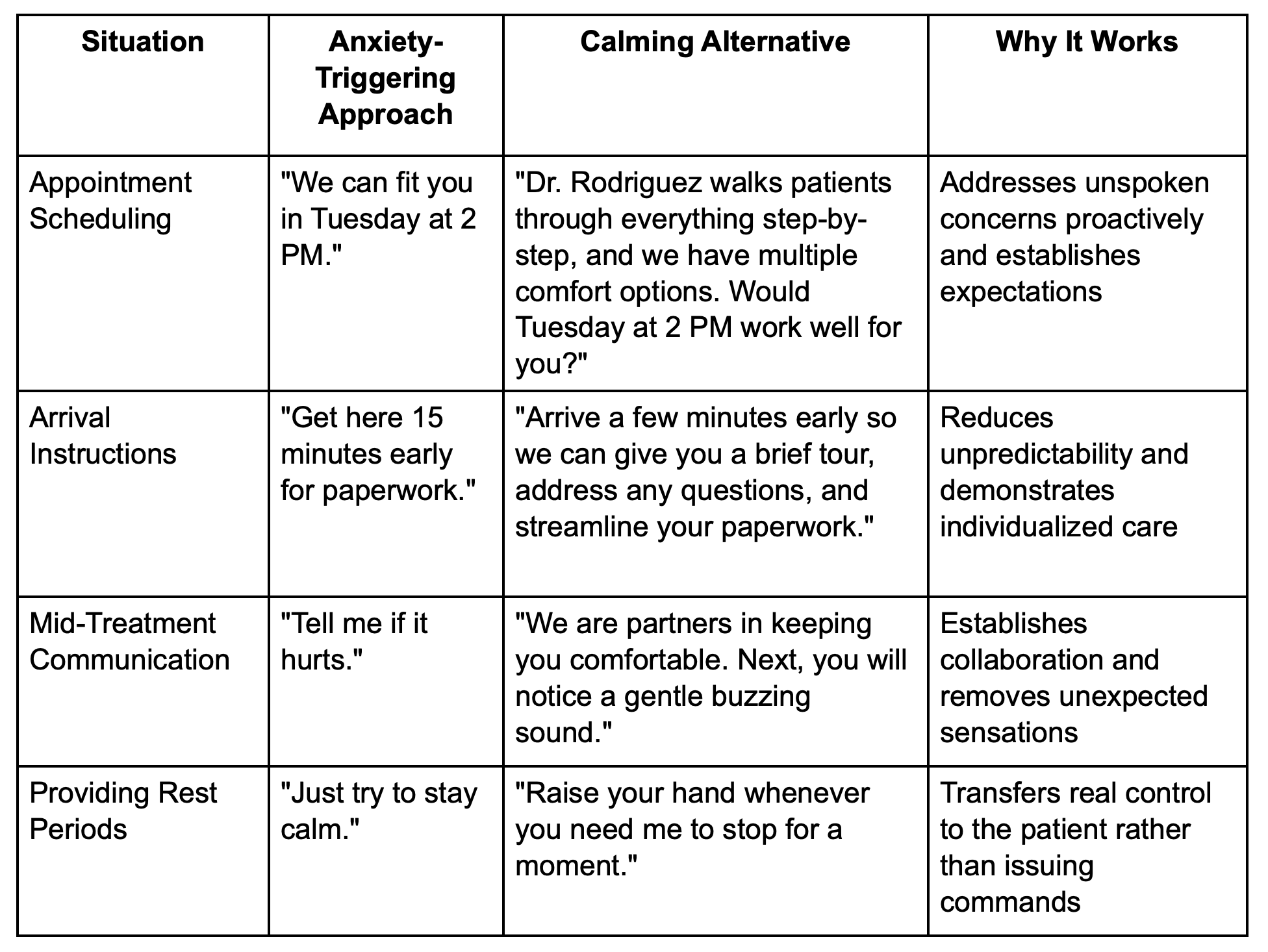
Your team's word choices either escalate or reduce patient anxiety. Minor adjustments in phrasing can completely change how nervous patients interpret their care experience.
Many dental teams unknowingly use phrases that activate patient anxiety. Terms such as "pain," "hurt," and "discomfort" engage the same neural pathways as actual physical experiences. Conversely, language emphasizing collaboration and predictability helps patients feel secure.
Genuine inclusivity is not about virtue signaling or superficial gestures. It represents smart business practice and improved care delivery for your entire community. Cultural considerations substantially affect patient behavior, treatment acceptance decisions, and sustained loyalty.
Examine community demographic information to understand who resides in your service area. If substantial portions of your neighborhood speak Spanish, employing bilingual staff members or maintaining access to professional interpreters becomes essential for informed consent and quality treatment, not merely helpful.
Connect with local cultural groups to gain insight into specific healthcare perspectives within your community. Different cultural backgrounds shape varying attitudes toward pain management approaches, preventive care importance, and comfort with medical authority figures.
Tour your practice with an outsider's perspective. Examine the wall art, marketing materials, and photos displayed throughout your location. Do these images authentically represent the patients you actually treat, or do they feature generic stock photography that fails to connect with your community?
Featuring work from neighborhood artists or photography genuinely reflecting your region communicates that you recognize and appreciate your diverse patient population. Inclusive dental marketing strategies enable practices to build authentic community connections without appearing performative.
Patients from certain cultural backgrounds expect family participation in healthcare choices. Others strongly prefer individual privacy. Your office policies should accommodate both preferences instead of forcing everyone into identical experiences.
Awareness of significant cultural and religious holidays prevents scheduling conflicts and shows respect for patients' lives beyond dental appointments.
Numerous practices pour resources into cutting-edge pain management equipment. Laser systems, sedation alternatives, sophisticated anesthetic delivery methods, these technologies certainly contribute value. However, when patients enter an anxiety-provoking environment and encounter team members using fear-based language, even sophisticated technology cannot create positive experiences.
Patient comfort functions as an integrated system rather than separate components. The physical atmosphere and communication approaches your team employs establish the groundwork that magnifies every other investment. When you prioritize soothing environments and anxiety-conscious communication, your practice becomes somewhere patients genuinely look forward to visiting.
Creating a successful dental practice means understanding that this comfort foundation amplifies all your other efforts. Establish the right environment and communication patterns first, and your technology investments will generate the outcomes you expect.
Comprehending the patient journey from discovery to loyalty illuminates how every interaction influences outcomes, from initial online searches to patients enthusiastically recommending you to acquaintances. Online reviews frequently highlight atmosphere and treatment experience over clinical procedures alone.
Building an anxiety-reduced practice does not demand complete space renovations or enormous budgets. Focused modifications to lighting design, acoustic management, visual barriers, and natural features, paired with deliberate communication development, can substantially transform patient experiences with your care.
When patients feel genuinely comfortable and respected, they maintain consistent appointments, agree to recommended procedures, and become your strongest promoters. Practices that achieve lasting success recognize patient comfort as the essential foundation supporting all other business elements. Select one strategy from this article and execute it this week, then expand from that starting point.
Q: What represents the most budget-friendly modification I can implement to decrease patient anxiety?
A: Switching from cool fluorescent lighting to warm LED bulbs delivers significant impact at minimal expense. Pair this with training your team on anxiety-conscious communication techniques for meaningful improvements without major financial commitment.
Q: Can smaller dental offices match larger facilities in patient comfort?
A: Definitely. Smaller practices frequently possess inherent advantages for developing personal, inviting atmospheres. Concentrate on genuine hospitality, reliable communication patterns, and considerate details such as greenery or quality seating instead of costly technology or extensive remodeling.
Q: Do comfort enhancements genuinely influence treatment acceptance?
A: Yes. Studies repeatedly demonstrate that relaxed, comfortable patients show greater willingness to accept comprehensive treatment recommendations and maintain stronger adherence to preventive care protocols.
Q: How can I measure whether my anxiety-reduction initiatives are succeeding?
A: Monitor metrics including appointment completion percentages, punctuality rates, patient satisfaction measurements, and referral volume. Short post-appointment surveys requesting comfort level ratings provide direct evidence of your improvement effectiveness.
Q: Should anxiety-reduction communication training include my entire staff, or primarily reception personnel?
A: Every team member who contacts patients requires training. Anxiety can emerge or diminish at any stage of a visit, so uniformity across all staff members is critical for maintaining a consistently comfortable experience.