
Think about what happens when a new associate joins your practice. From day one, they might be perfectly capable. Maybe they're even exceptional. But would you hand them your most complex, high-value treatment plan in the first week? Probably not. You watch how they perform. You review their work. You increase their responsibilities as they demonstrate, over time, that they deserve it.
Google operates with the same instinct.
When a dental practice builds a website, uploads some content, and submits it to Google, the search engine does not immediately hand over a top spot in the rankings. That would be reckless. Instead, Google takes a measured look at the evidence available, and only when enough of that evidence points to a trustworthy, helpful, established source does it begin rewarding that practice with meaningful visibility.
This is not a flaw. It is the entire mechanism that keeps search results useful. And once you understand how it works, your dental SEO strategy becomes a lot less frustrating and a lot more strategic.
Before Google can rank you, it has to find you. Automated programs called crawlers travel the web following links from page to page, reading what they find, and storing that information in a massive index. Think of it as a library catalog that never stops growing.
Once your site is indexed, it enters the library. But being on the shelf and being at the front desk are very different things. Earning that prominent placement is where the real work begins.
After your site is discovered, Google evaluates the quality and depth of what you have actually published. Generic copy that could belong to any dental practice in any city sends a quiet signal: this site is not an authority on anything specific.
The practices that earn rankings publish content that genuinely helps patients. Detailed service pages that explain procedures. Blog posts that answer the actual questions patients type into search bars. Location-specific language that shows a real connection to a real community.
Regularly publishing helpful, relevant content also signals to Google that your site is active, not abandoned. This matters more than many practice owners realize. If you want to understand the most important dental SEO strategies and how to apply them, a good deep dive into content and technical fundamentals pays off.
Here is where an analogy from dentistry itself becomes useful.
You know how powerful a word-of-mouth referral is. When a happy patient sends a friend or neighbor to your practice, that recommendation carries far more weight than any ad ever could. It is trust transferred from one person to another.
Backlinks work the same way, except they are websites doing the endorsing. When a credible source, a dental journal, a local news outlet, a well-known health directory, links to your website, Google interprets that as a signal that your practice has something worth pointing people toward. These endorsements accumulate over time and build what is often called domain authority.
The important thing to understand is that not all backlinks carry equal weight. A link from a directory no one visits is not the same as a link from a respected healthcare publication. Quality matters far more than quantity. This is also why your dental reputation management strategy, including how you appear in directories and how patients talk about your practice online, directly feeds your SEO. Reviews, citations, and mentions across the web all contribute to the trust picture Google assembles about your practice.
This is the piece that surprises most dentists and office managers when they hear it.
Google watches what happens after someone clicks your listing. Two metrics carry significant influence here:
Click-through rate (CTR): Out of everyone who sees your practice appear in search results, what percentage actually clicks? If the number is low, Google suspects your listing is not a strong match for what people are searching for.
Dwell time: Once someone clicks and lands on your site, how long do they stay? If visitors consistently land and immediately leave, that is a red flag. It signals that your content did not deliver on the expectation your listing created.
On the other hand, when patients arrive on your site and explore, read, and eventually book, Google takes note. Positive user behavior is one of the quiet forces that incrementally pushes rankings upward. This is exactly why well-designed dental websites do so much more than look good. Speed, clarity, and ease of navigation directly influence how long visitors stay, which directly influences your search position.
Here is something worth knowing: Google does not make a single decision and move on. It experiments.
When you publish new content or improve your site, Google may temporarily bump your ranking to observe what happens. If engagement metrics respond positively, that movement tends to hold and build. If the traffic bounces quickly, Google pulls back. This cycle repeats many times before your ranking stabilizes at a level that reflects how much trust you have actually accumulated.
That is why Google's AI Overviews has become an increasingly relevant conversation. The rules are evolving, and practices with established content authority are the ones already positioned to benefit.
Here is an honest truth that often gets skipped over.
If the top-ranked practice in your market has been consistently building content, earning backlinks, and gathering reviews for the past four years, they have four years of accumulated trust that simply cannot be manufactured overnight. This does not mean you cannot outrank them eventually. It means the timeline is real, and your efforts today are laying the groundwork for the wins that arrive later.
In smaller markets or less competitive communities, the bar is lower, and results often appear faster. In dense urban markets, patience and persistence matter more. Either way, the approach is the same: build trust signals consistently, across every channel.
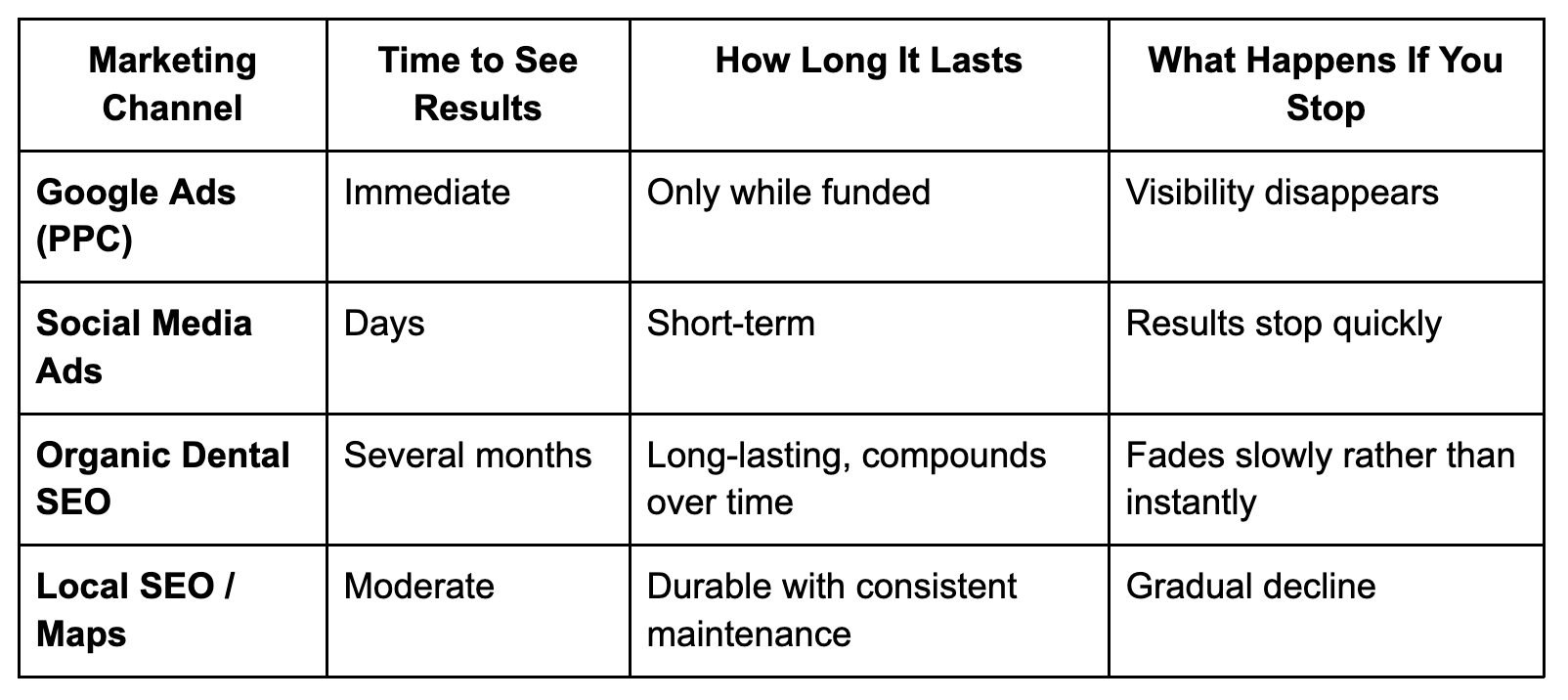
The table above illustrates something important. Paid advertising delivers quick visibility, but the moment the budget pauses, so does the traffic. Dental SEO, by contrast, builds something durable. The content you publish today can bring in new patients next year and the year after that. It is the difference between buying flowers and planting a garden.
This is also why, if you want results while your organic rankings are still developing, combining Google Ads and organic SEO makes sense. Paid search fills the short-term gap while your organic foundation takes root. And it is worth staying current on how AI is reshaping discovery, because zero-click searches and AI Overviews are already changing the way patients find practices online.
You do not have to sit and wait. There are concrete actions that move things in the right direction:
And if you are trying to understand where the landscape is headed, the conversation around GEO versus traditional SEO in the age of AI assistants is one worth getting familiar with before your competitors do.
Google is not ignoring you. The search engine is doing exactly what it was built to do: taking its time to verify that you actually deserve to be recommended to the patients who are counting on it for accurate, helpful results. Every quality article you publish, every backlink you earn, and every patient who spends time exploring your site is quietly building the case that you do. Show up consistently, stay patient with the process, and let compounding do what compounding does.
Q: How long does dental SEO typically take to show results?
A: Most practices begin to see measurable movement in rankings within four to six months of consistent effort, though more competitive markets often take longer. The key variable is not just time but the quality and consistency of the trust signals being built throughout that period.
Q: Why does Google care whether visitors stay on my website or leave quickly?
A: When patients land on your site and immediately leave, it tells Google that your page did not deliver what they were expecting. Sustained engagement, reading multiple pages, scrolling through content, or booking an appointment, signals the opposite and gradually improves your standing in search results.
Q: Can I speed up dental SEO by spending more money?
A: Paying for Google Ads can get your practice visible immediately, but that visibility is tied entirely to the budget. Organic SEO cannot be purchased directly; it is earned through consistent content, backlinks, and user behavior. The two approaches work best together, especially in the early months when organic rankings are still developing.
Q: Does my practice's online reputation actually affect SEO rankings?
A: Yes, significantly. Reviews, directory listings, and mentions across the web all contribute to how Google perceives your authority and trustworthiness. A strong, active reputation management strategy directly supports your organic visibility.
Q: What happens to my SEO if I stop publishing content?
A: Unlike paid advertising, your rankings do not vanish immediately when content production slows. However, over time, a lack of fresh, relevant material signals to Google that your site is stagnant. Competitors who keep publishing will gradually earn more trust, and your rankings will drift downward as a result.