Picture a small town library sometime around 1985. Every book has a card in a big wooden catalog drawer. If a book isn't in that drawer, as far as the library is concerned, it doesn't exist. Someone could hand-write the most brilliant novel in history, but if nobody files a card for it, no one ever finds it on the shelf.
That's basically what indexing used to mean for websites. Search engines like Google sent out little digital librarians (called crawlers or bots) to scan the internet, read the text on a page, and file a "card" for it in a massive digital catalog. If your practice's website wasn't crawled and filed away correctly, it simply didn't show up when someone searched "dentist near me." Your practice could exist in real life, be full of five star reviews, and still be functionally invisible online.
For most of the 2010s, that was the whole game. Dentists focused almost entirely on their website: blog posts, service pages, meta descriptions, all written and formatted so Google's crawlers could read and file them correctly. Social media was treated as a separate, almost disconnected activity, more like a bulletin board for existing patients than a tool for getting found by new ones.
Here's the plot twist. The "library" got a lot bigger, and the librarians got a lot smarter. Search engines and AI assistants no longer just crawl websites. They now crawl and index social media content too, including Instagram Reels, TikTok videos, and YouTube Shorts. Your video content and its captions are being read, categorized, and sometimes surfaced directly in a search result or an AI generated answer, the same way a blog post used to be, which is essentially how AI assistants are revolutionizing dental marketing and rewriting the rules of what counts as "indexable" content in the first place.
Think of it like the library suddenly deciding that every conversation happening in the community center down the street also counts as public information worth cataloging. That shift is why a full list of dental social media video ideas has become just as important to your visibility as your website copy. It genuinely amounts to a complete social media makeover thanks to AI, whether your practice was ready for it or not.
This matters enormously for your practice. A patient searching "gentle dentist for kids in my area" might now be shown an AI generated summary that pulls directly from a caption on your Instagram video, not just from your homepage. If that caption is vague, generic, or missing entirely, the opportunity disappears, even if the video itself was great. This is largely because of how AI search engines now generate answers instead of links, which is exactly why the text around your video carries so much weight now.
Photos still have their place, but video does something a static image simply cannot: it holds attention. Social platforms track how long someone watches before scrolling away, and that watch time signals to the algorithm that your content deserves to be shown to more people. A caption alone can't compete with fifteen or thirty seconds of a real patient talking about how comfortable their visit was, which is why Instagram posts actually matter now in ways they simply didn't a few years ago.
Video also builds trust faster than almost any other content type. Meeting your dental team through a video feels closer to meeting them in person than reading a written bio ever could. Patients hear tone of voice, see facial expressions, and pick up on warmth that text can't convey. For anxious patients especially, watching a short video of your office or a "what to expect" walkthrough can meaningfully lower the fear of the unknown before they ever schedule an appointment. Even a practice with no interest in becoming a social media powerhouse can build AI-ready content, even for practices that dread social media, once the process is broken down into small, repeatable steps.
It's also worth noting how fast the underlying technology is moving. Generative video is advancing quickly, and new AI video tools are opening up a lot of creative room for dental practices, even if a smartphone and good lighting remain more than enough to get started today.
You don't need a production studio or a professional camera crew. A smartphone, a bit of natural light, and a simple plan are enough to get started. Here are the video formats that consistently perform well for dental practices:
If you're wondering whether this level of effort is really necessary, the honest answer comes down to rethinking social media in the age of AI rather than treating it as an afterthought. Patient behavior has already moved, so practice strategy has to move with it.
Here's the part that surprises most dental professionals: the caption underneath your video may carry more weight for discoverability than the footage. AI search tools rely heavily on text to understand what a video is actually about. A caption, along with any on-screen text or transcript, tells both human viewers and AI assistants exactly what your video answers.
A video with no caption, or a caption that just says "Happy Friday from our team!", gives search engines almost nothing to work with. A caption that says "Our hygienist Sarah shares a quick tip on how to properly floss around braces" gives both patients and AI systems specific, useful, indexable information. That difference can be the reason one practice's video shows up in a patient's search and another video doesn't, even if they are similar in quality. Captions are one of the simplest places to start when it comes to teaching AI to find and recommend your practice.
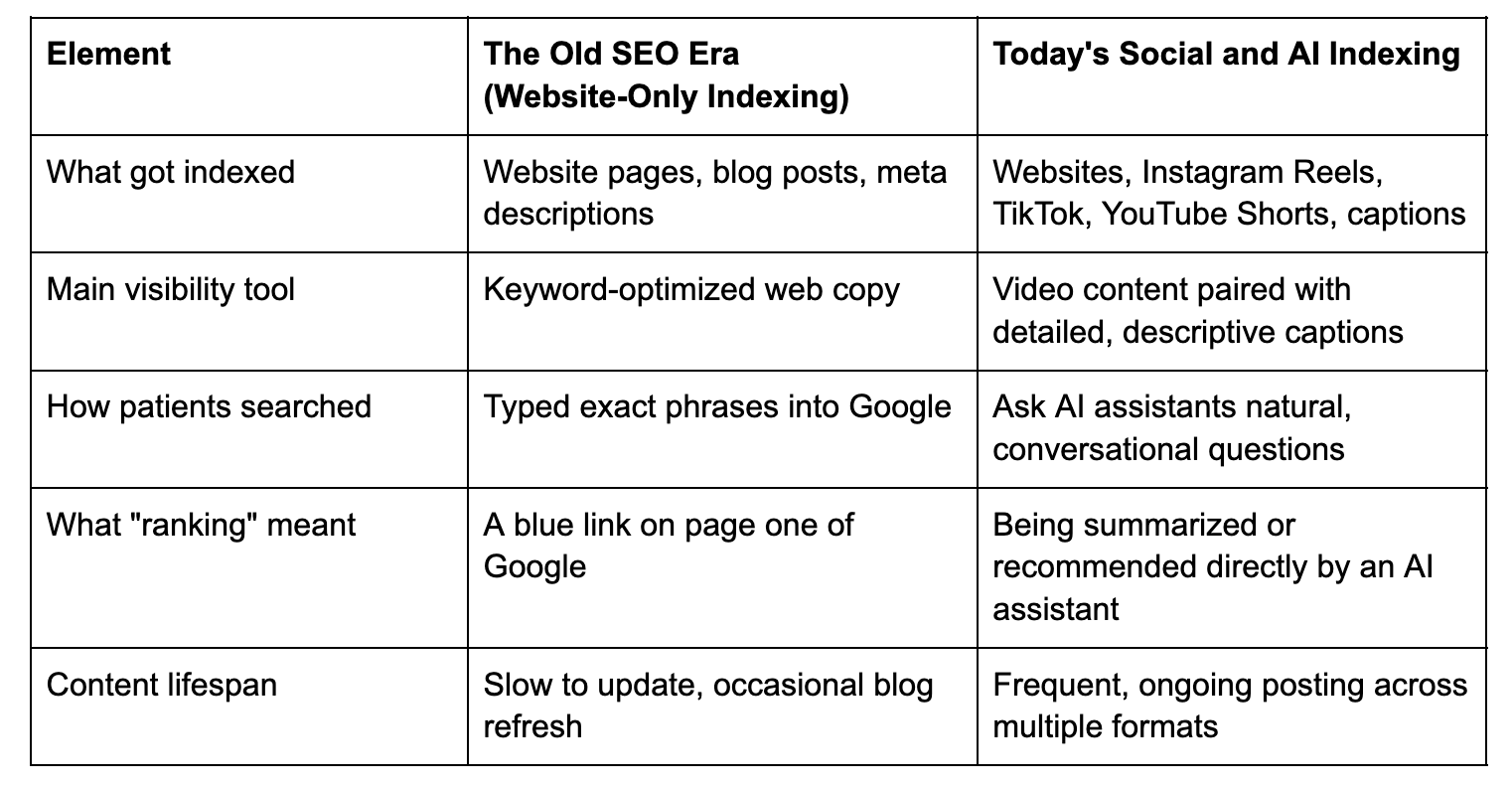
Start small and stay consistent rather than trying to produce a perfectly polished video once a year. A short, well-captioned video posted weekly will almost always outperform a single expensive production that sits untouched for months. Assign one team member to own the process: filming, writing captions, and posting on a simple schedule. Over time, this consistency builds a library of content that continues to work for your practice long after it's posted, especially as search terms and patient language continue to evolve alongside AI-driven ranking factors.
It also helps to understand the bigger picture behind this shift. How AI is reshaping dental practices comes down to this central point: the goal isn't to chase every new tool, it's to consistently give AI systems clear, well-organized content to work with. This is a shift practices can't afford to ignore, since the practices that adapt early are the ones patients and AI assistants alike will find first.
Video dental marketing isn't a passing trend. It's become one of the clearest ways for your practice to be found, understood, and recommended by both patients and the AI tools they increasingly rely on. The formula is simple even if it takes consistency to execute: film short, authentic videos, write specific and descriptive captions, and post regularly. Take the first step today by picking just one video idea from this list and filming it this week.
A: Yes. Platforms like Instagram, TikTok, and YouTube are now crawled by search engines and AI assistants, which means your video content and captions can appear in search results and AI generated answers, not just in social feeds.
A: A simple "what to expect" walkthrough or a team spotlight clip is a great starting point. Both are easy to film with a smartphone and immediately help reduce patient anxiety.
A: AI search tools and algorithms rely on text to understand what a video is about. A detailed, specific caption gives both patients and AI assistants the context needed to recommend your content.
A: Posting consistently, even just once a week, builds far more trust and visibility over time than posting one highly produced video a year.
A: Absolutely. Videos that walk through a procedure or show a tour of the office remove much of the uncertainty that fuels dental anxiety, helping nervous patients feel more comfortable before their visit.