
What You'll Learn:
Search is changing fast.
A growing slice of patients are skipping Google altogether and heading straight to ChatGPT, Gemini, or Perplexity to find a dentist. And here's the part that should get your attention: roughly 60% of all searches now end without a single click. Patients get their answer directly in the AI overview and never visit a website. If your practice isn't named in that overview, you simply don't exist in that moment.
Understanding the difference between GEO vs. SEO in dental marketing is the starting point. Once you understand how AI search works differently from traditional Google rankings, the logic behind an AI SEO audit starts to make a lot of sense.
Traditional SEO asked: "Where does my website rank for this keyword?"
An AI SEO audit asks something more useful: "Would an AI confidently recommend my practice to someone looking for a dentist right now?"
AI doesn't just crawl your website. It scans five types of sources, cross-references them, and decides who the credible local dental authority is. Weak or inconsistent signals across those five areas, and AI passes you over - even if you have a great practice and a beautiful website. Learning how AI for dental SEO works differently from traditional ranking helps frame what you're actually checking for.
Here's how to audit all five.
1. Your Website
Think of your website as your digital textbook. AI reads it to verify what you do, where you are, and whether you can be trusted. Ask yourself:
If your site feels outdated or slow, that's where to start. Building an AI-friendly dental website is one of the highest-impact moves you can make for AI visibility.
2. Google Business Profile
Your Google Business Profile (GBP) is your identity record. AI treats it like an official ID badge. Check:
Most practices set up their GBP once and forget it. That's a real problem. Ranking on Google Maps for dentists requires consistent activity, and so does appearing in AI recommendations.
3. Social Media
Your posts are indexed as real content, and video is weighted roughly twice as heavily as photos. For your audit:
Most practices overlook this piece entirely. Making sure your practice has AI-ready content across social platforms is a relatively quick win.
4. Online Directories
Directories act as reference checks. AI asks: "Do multiple trusted sources agree on who this practice is?" Check consistency across Google Business Profile, Bing Places, Yelp, Healthgrades, and WebMD.
Your name, address, and phone number - your NAP - must be identical across all of them. Even a small variation like "Suite 100" vs. "#100" can confuse AI engines and weaken your authority signal.
5. Patient Reviews
Reviews are the highest-trust fuel AI uses. They provide unbiased, third-party proof that real patients had a good experience. Audit these three things:
Recency matters just as much as total volume. Find out how to consistently get more Google reviews for your practice so your review signals stay fresh and relevant.
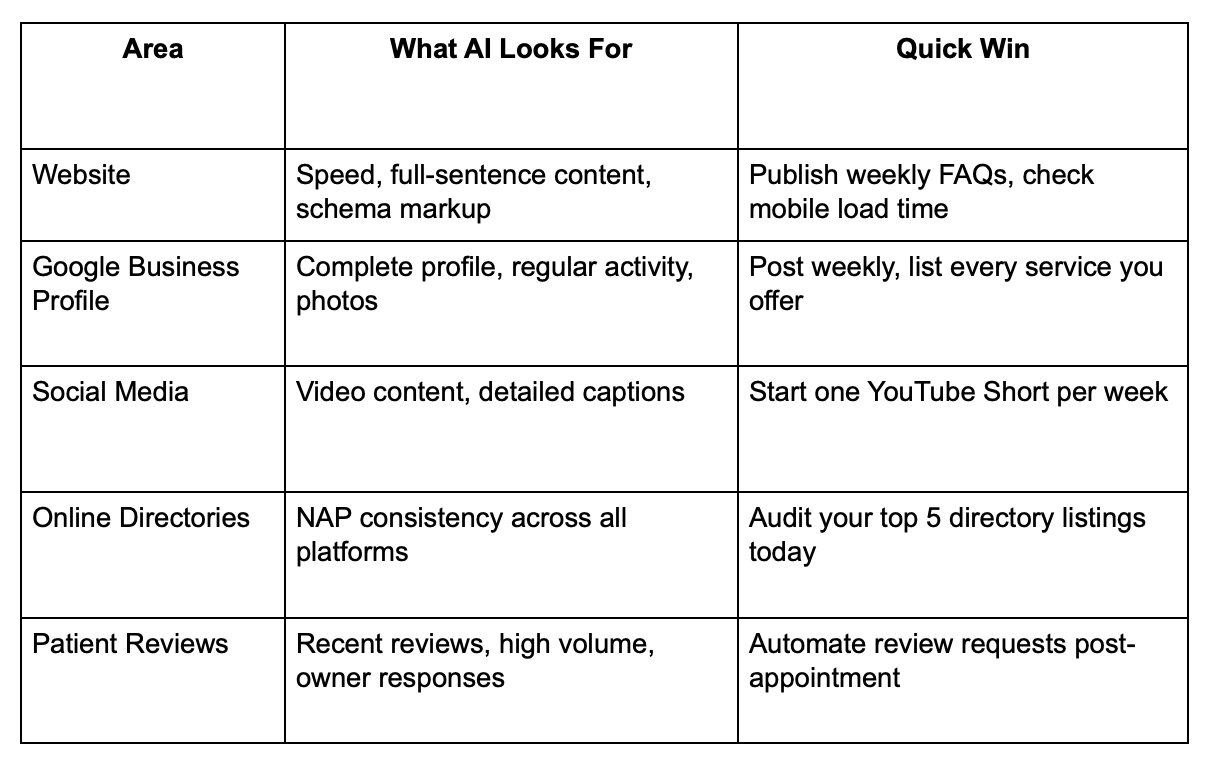
You don't need to fix everything at once.
Start by opening ChatGPT or Gemini and typing: "Who are the best dentists in [your city]?" If your practice doesn't appear, that's your baseline and your motivation.
From there, pick the weakest area from your audit and work on it first. Most practices see the biggest early gains from improving GBP activity and review recency - both of which can be addressed in a single afternoon. For a deeper look at how your overall dentist SEO strategy should evolve alongside AI search, that's worth exploring as you build momentum.
AI is already sending patients to dental practices - just not every practice. An AI SEO audit tells you exactly where the gaps are so you can close them before a competitor does. Start with your five key areas, fix the lowest-hanging fruit first, and repeat the audit every quarter to stay ahead of how AI search continues to evolve. The first-mover advantage is real, and it belongs to whichever practice acts now.
Q: What is an AI SEO audit for a dental practice? A: It's a structured review of the five sources AI search engines use to verify and recommend local businesses: your website, Google Business Profile, social media, online directories, and patient reviews. The goal is to find and fix gaps that prevent AI from recommending your practice.
Q: How is an AI SEO audit different from a traditional SEO audit? A: A traditional SEO audit focuses on keyword rankings and website performance. An AI SEO audit evaluates all the sources AI uses to verify your credibility across the web, including review recency, social activity, and directory consistency - not just your site.
Q: How often should I run an AI SEO audit? A: Quarterly is a smart rhythm. AI models update their data sources frequently, so what worked six months ago may not be enough today. A quick check every 90 days helps you catch gaps before they cost you new patients.
Q: Can I run an AI SEO audit myself without a marketing team? A: Yes, for the basics. Search your practice name on ChatGPT and Gemini to see if you appear. Check your GBP for completeness, audit your top five directory listings for NAP consistency, and look at your most recent Google review date. Those four steps alone will reveal a lot.
Q: Why do patient reviews specifically matter for AI search? A: AI engines use reviews as third-party validation - unbiased opinions from real patients, which makes them high-trust signals. Both the number of reviews and how recently they were posted influence whether AI includes your practice in its recommendations.