Let's start simple. A backlink is just a link from someone else's website pointing back to yours. That's it. If a local news site writes about your practice's community fundraiser and links to your website, that's a backlink. If a dental publication mentions your blog post about same-day crowns, that's a backlink too.
Think of it like a referral. If one patient tells a friend "you should really see Dr. Smith," that's word of mouth. A backlink is the online version of that same recommendation, except search engines can actually count it, measure it, and use it to decide how trustworthy your practice looks.
For close to 25 years, backlinks have been one of the biggest ranking factors in SEO for dentists. Google's original algorithm was practically built around the idea that a page with lots of quality links pointing to it must be worth showing to searchers.
Here's the traditional logic, and it still holds up in plenty of ways. Google's crawlers scan the web constantly, and every time they find a link from Site A to Site B, they treat it as a small vote of confidence. The more votes a page collects, especially from reputable, relevant sites, the more Google trusts that page enough to rank it higher.
But not all votes count equally. A link from a well-known dental publication carries far more weight than a link from a random directory nobody visits. Over the years, a few things came to define what a "good" backlink actually looks like:
Practices that built genuine, quality links from reputable sources consistently outranked competitors who tried to shortcut the process with cheap, low-value links. That part of the story hasn't changed. What has changed is who, or what, is doing the searching.
Here's where things get interesting. More patients are no longer typing "dentist near me" into Google and scrolling through ten blue links. They're asking ChatGPT, Perplexity, or Google's AI Overviews a direct question, something like "which dentist in my area offers same-day crowns" or "is it normal for a filling to hurt afterward." The AI reads across the web, pulls together an answer, and sometimes recommends a specific practice, all without the patient ever clicking through to a website.
If that sounds like a completely different game, don't worry. It's not as different as it seems, and we're going to break down exactly why in plain language.
AI search tools still need to figure out which sources to trust. They're not pulling answers out of thin air. Behind the scenes, these systems are trained on huge amounts of web content, and they still lean heavily on signals like authority, structure, and trust signals (backlinks very much included) still shape which practices get referenced.
The difference is that AI models weigh a wider mix of signals than old-school SEO did. It's less about stacking as many links as possible and more about proving your practice is a credible, well-referenced source across the internet. AI models scan hundreds of sources, evaluate author credentials, freshness, and specificity, and then generate a consolidated answer, often citing the sites it trusts most as sources along the way.
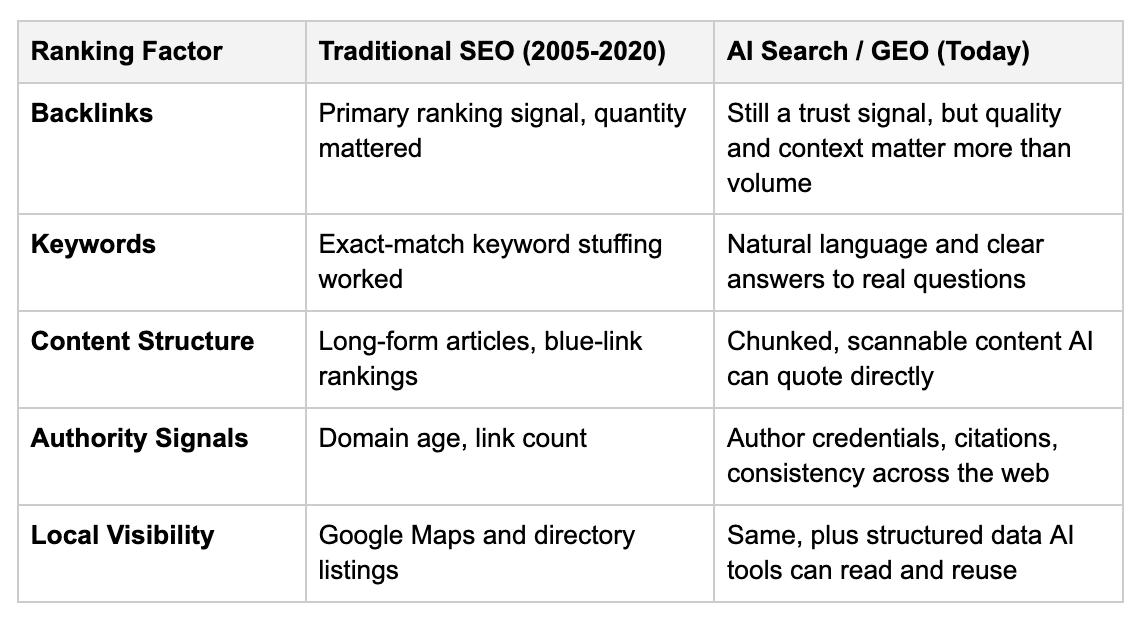
Short answer: yes, but their job has shifted. Backlinks used to be treated almost like a scoreboard, more links, higher ranking. Now they function more like references in a research paper. AI tools use them as one of many signals to decide whether your practice is a credible source worth citing.
Practices that show up in Google's AI Overviews tend to have strong backlink profiles alongside clear, well-organized content that directly answers patient questions. The link alone won't do the job anymore. It has to point to content that's genuinely useful, or the AI has little reason to reference it.
This is also true for local visibility. A steady base of quality backlinks still supports ranking on Google Maps and in local search results, which remains one of the most reliable ways new patients find a practice, whether they're using traditional search or asking an AI assistant for a nearby recommendation.
If your site currently has broken links, thin content, or a backlink profile built on low-quality directories, that's worth fixing regardless of how patients are searching. According to a breakdown of simple SEO fixes dental websites can't afford to miss, building high-quality backlinks from trusted dental and local sources remains one of the fundamentals, right alongside site speed, mobile performance, and clean on-page structure.
At the same time, it's worth preparing your website's content to be AI-ready, meaning clear, text-based, well-organized pages that both human patients and AI crawlers can easily understand. A backlink pointing to a confusing, cluttered page doesn't do much good, no matter how many of them you have.
You don't need to overhaul your entire marketing plan overnight. A few practical moves can strengthen your backlink profile for traditional search and AI search at the same time:
It also helps to understand the bigger shift happening in search overall. Generative Engine Optimization is less about chasing rankings and more about making sure AI tools can extract, understand, and confidently cite your content. Backlinks are part of that picture, not the whole picture. And as voice and conversational search continue to grow, the practices that combine strong backlinks with clear, conversational content are the ones most likely to get mentioned when a patient asks an AI assistant for a recommendation.
Backlinks haven't disappeared, and they're not going anywhere anytime soon. What's changed is the standard. AI search tools care less about how many links point to your site and more about whether those links come from credible, relevant sources pointing to content that actually answers patient questions. Build with that standard in mind, and your practice stays visible no matter how the search landscape keeps evolving.
Now that you understand where backlinks fit into today's AI-driven search world, take the first step by reviewing your current link profile and cleaning up anything low-quality or outdated. Small, consistent improvements now will pay off as more patients turn to AI assistants for their dental recommendations.
A: Yes. Backlinks remain a trust signal for both traditional search engines and AI search tools. What's changed is the emphasis on quality and relevance over sheer quantity.
A: Traditional search shows a list of ranked links for a user to click through. AI search tools like ChatGPT and Google's AI Overviews read across many sources and generate a direct answer, sometimes citing or recommending specific practices without the patient ever visiting the website.
A: A high-quality backlink usually comes from a relevant, reputable source, such as a dental publication, local news outlet, or trusted directory, and it's placed naturally within useful content rather than stuffed into a spammy list.
A: It's possible, but unlikely to be consistent. AI tools rely on authority and trust signals to decide which sources to cite, and backlinks remain one of the clearest indicators of a credible practice.
A: Both work together. A backlink pointing to unclear or outdated content won't help much, and great content with no backlinks may struggle to build authority. Start by cleaning up your site's content, then build backlinks from relevant, trustworthy sources.